
A Personal Confession
On Abortion, Silence, Complicity, and Accountability

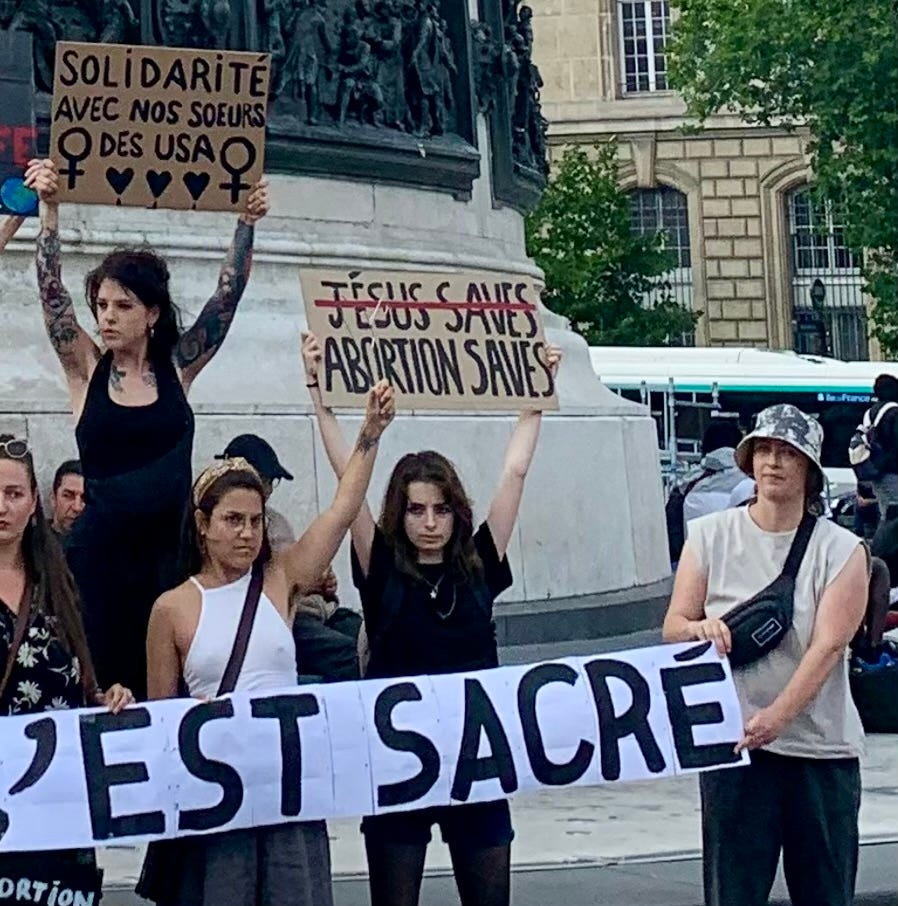
I was in Paris last Friday when the U.S. Supreme Court’s decision to overturn Roe v. Wade was announced. Within hours, women gathered in one of Paris’ central squares to protest the decision in solidarity with their American sisters. Passing by this protest on my way to dinner, I was both heartened and disturbed by their show of support.
Does Jesus save? Does abortion save? What is the relationship between these two experiences? I don’t know. I do know that the complexity of the answer can not be reduced to a slogan on a placard. I do know that the destruction of the fragile consensus of Roe v. Wade will only make it more difficult to explore that question in our polarized nation. I do know that it will make women’s lives and their struggle for equality more difficult. And that will diminish all of us.
Was Roe v. Wade perfect? No, but it was more or less adequate in our imperfect world, and simply overturning it will not improve it. It also places at risk a whole range of rights based on the constitutional principle of a right to privacy upon which Roe v. Wade was grounded. Women are always the thin edge of the wedge for justice. When that edge is blunted, it makes other groups vulnerable as well.
I’ve been thinking about the sign pictured above in which “Jesus saves” is crossed out and replaced by “Abortion saves.” This was the image that disturbed me even as I was heartened by the show of support. Is there a relationship between Jesus and abortion other than that promoted by right-wing Christianity? Can one follow the way of Jesus and affirm that access to abortion is a necessary option to protect the health and dignity of women?
For many years now, the Episcopal Church has answered these questions in the affirmative through a series of General Convention resolutions. But General Convention resolutions don’t provide much theological depth or moral guidance, and they don’t even begin to address the pastoral realities to which they seek to respond.
In 20 years of ordained ministry, only one or two women confided to me that she had or was contemplating an abortion. Perhaps my female colleagues have had a much different experience, but I wonder. There exists a deeply pervasive norm of silence around abortion that is far more profound than almost any other experience at the intersection of medicine and ethics. When privacy is reduced to secrecy, silence often signals fear and shame.
The Church must be held accountable for its complicity in promoting such fear and shame. I, too, must be held accountable. In 20 years of ordained ministry, I’ve never preached a sermon or fostered any public context for reflection on the issue of abortion. Silence. I should know better as a gay man who lived through the worst of the AIDS pandemic that such silence equals death. My silence has contributed to the impasse in which we now find ourselves, and made it more difficult for my sisters to find their voices.
I can only apologize to them for my silence, and commit to amendment of life, beginning here and now.
I also acknowledge that my silence ignored the pastoral needs of women who have undergone abortion procedures. Such decisions are never taken lightly, and are accompanied by complicated feelings of relief and grief. Our society, and our Church, fail to provide safe spaces and rituals to acknowledge and heal from the tragic aspects of abortion. Abortion can save women’s lives. The protestor in Paris got that part right. But the need for healing, integration, and renewal of life does not end with the procedure at the clinic. Abortion would be far less common if placed within an authentically pro-life context of reproductive education, universal health care (including contraception), and social policies promotiong women’s equality in the workplace, paid parental leave, universal child care, and male responsibility for our behavior and its consequences. Here, those of us who love Jesus have our part to play; if we really love as Jesus loves.
Finally, I acknowledge my inadequacy to talk about abortion in a theologically meaningful way. This is, in part, due to a lack of pastoral experience to ground such language, but it also is due to the limitations of our inherited tradition’s teaching on the topic.
I want to commend the Rev. Dr. Cynthia Bourgeault for her brave and provocative theological discussion of abortion in a 7-part series of blog posts she wrote in 2017. She delineates more precisely between life, human individuality, personhood, and soul-making as a developmental process over the course of a lifetime. She also invites a little more humilty and compassion before the mystery surrounding the liminal spaces that mark the “before” and “after” of life. Abortion raises important questions about the meaning of life and death that I/we too often avoid.
Dr. Bourgeault models the kind of conversation I would like to initiate and I offer her teaching as a starting place (not an ending place). It is time for me to break silence, and to engage in the difficult, ongoing conversation about abortion that the U.S. Supreme Court has now made it impossible to ignore.