
Seeing and Abiding
A sermon for the 2nd Sunday after the Epiphany

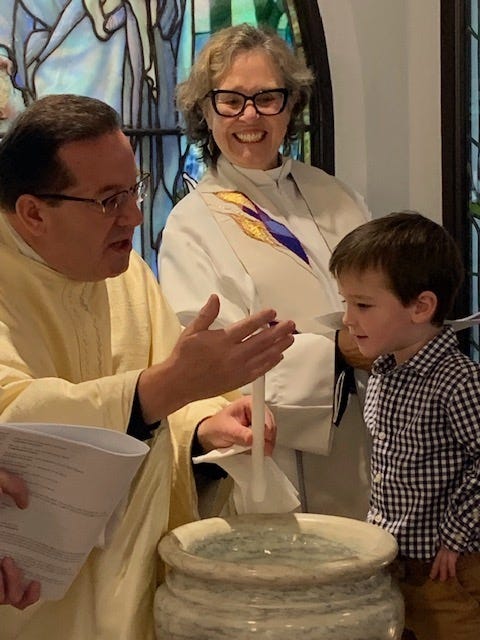
This week I have been much taken by an image of Bradley’s baptism on the Feast of the Baptism of our Lord, captured by Mary Balmana. In this photograph, Pastor Shari looks on as I present the baptismal candle to Bradley, newly lit from the Paschal Candle. It is a symbol of the light of Christ. Contemplating this image, I am struck by the reverence with which I present this light; the wonder and anticipation with which Bradley receives it; and the joy with which Pastor Shari views this sharing of the light. It captures a very precious experience.
We are drawn together by the light of Christ at the center of our attention. In that moment, we see it with clarity. We are illumined by it. The patristic writers of the Eastern church describe the experience of baptismal initiation as photismos, “illumination” or even “enlightenment.” We were right there in that moment, fully present. This light is the center around which we experience our unity. And, in that light, we found not only union, but rest. Nothing else was required. We had everything we needed.
Oh, the experience didn’t last long, but we were able to abide in it for a moment; a moment that touched into eternity. We were in illo tempore, in that “time before time,” “in the beginning,” when God said, “Let there be light.”[1] Baptismal initiation is a remembrance of the light that is our origin, our identity, and our destiny. We are children of the light. [2]
John’s Gospel begins with a prologue that is, at its heart, a kind of poetic evocation of our baptismal identity. We are told that John the baptizer was sent to testify to the light, the light that was with God at the very beginning of creation. “The true light, which enlightens everyone, was coming into the world.”[3] The light entered into history, took shape in a human being, so that in that light we may see light; so that we may recognize our own identity. All who receive this light, who bask in its brilliance, receive power to become children of God.
This seeing is a kind of knowing, as when we say, “I see what you mean.” To see this light is to know that we are children of God. It is to know that we are intimately and intrinsically related siblings, all offspring of the light of that first great flaring forth that brings all things into being. Baptismal initiation enlightens us, reveals who we are, and unites us with the whole cosmos in the radiant light of Christ. We can abide in this light because it is our true and final home.
“Seeing” and “abiding” are themes that run throughout John’s Gospel. John the baptizer fulfills his destiny by testifying that in Jesus, the light has come into the world, baptizing us with holy spirit to illumine and empower us. This is what it looks like to be children of the light, to be children of God! Behold! See![4]
Jesus, the light of the world, begins to gather a community around him. He invites them to “come and see” and they remain or “abide” with him. It is interesting that the text tells us that it was about four o’clock in the afternoon when they stayed with him. It may well be that it was drawing close to sundown on the sabbath. In abiding with Jesus, they were abiding in sabbath rest, the divine rest established at the very beginning of creation.[5]
Later in John’s Gospel, Jesus tells his disciples, “Those who love me will keep my word [i.e., they will share his consciousness, be of one mind with him], and my Father will love them, and we will come to them and make our home with them.”[6] He goes on to describe this abiding together in the image of a vine and branches. Jesus is the true vine and we are the branches. If we abide in Jesus, like a branch in communion with the vine, then we will become ripe and bear much fruit.[7]
This “abiding” is an abiding in love. “As the Father has love me, so I have loved you; abide in my love . . . This is my commandment, that you love one another as I have loved you. No one has greater love than this, to lay down one’s life for one’s friends.”[8] Of course, that is precisely the greatness of Jesus’ love.
When John the baptizer sees Jesus, he proclaims, “Here is the Lamb of God who takes away the sin of the world.”[9] It is an allusion to the Passover lamb, the slaughtered lamb whose blood marked Jewish households for protection and became the sign of their liberation from slavery in Egypt. The light, the consciousness of God, comes into the world, in flesh, in history, to incarnate a liberating love. It takes away the sin of the world, untangles the knots in our relationships so that we can become free: free to love. Free to realize our unity in the light.
Baptismal enlightenment, recognizing our identity as children of God, is at same time an experience of union. We can find blessed rest in union with God and with creation. Baptism brings us back to the beginning, to our true identity and home. But this abiding does not leave us in contemplative bliss. It ripens us so that we can bear much fruit. It prepares us for the work of love in the world.
In his sermon, “Antidotes to Fear,” Dr. Martin Luther King, Jr. spoke of a dedicated leader of the civil rights movement in Montgomery, Alabama, named Mother Pollard. Mother Pollard was an elderly African-American woman of great intelligence and spirit, though she was dirt poor and without formal education. During the bus boycott in Montgomery to protest against segregation, old Mother Pollard walked everywhere, week after week. Finally, someone asked her if she was tired. She replied, “My feets is tired, but my soul is rested.”[10]
Mother Pollard spoke and acted out of her baptismal identity. She knew she was a child of God, a child of the light. She abided with Jesus, and found her rest with him. It gave her the power to endure in the work of love, even in the face of great evil. As Dr. King said, “The kind of love which led Christ to a cross and kept Paul unembittered amid the angry torrents of persecution is not soft, anemic, and sentimental. Such love confronts evil without flinching and shows in our popular parlance an infinite capacity ‘to take it.’ Such love overcomes the world even from a rough-hewn cross against the skyline.”[11]
As we work to take away the sin of the world, to untie the knots of the persistent structures of racism in our own day, and so many other forms of fear and hatred, let us take refuge in our baptismal identity. Let us see the light of Christ in ourselves and each other, and abide in God’s love. When we see and abide, our soul will be rested, even if “our feets are tired.”
[1] Genesis 1:3.
[2] I Thessalonians 5:5.
[3] John 1:9.
[4] John 1:29-34.
[5] John 1:35-39.
[6] John 14:23.
[7] John 15:1-8.
[8] John 15:9,12.
[9] John 1:29.
[10] The Rev. Dr. Martin Luther King, Jr., Strength to Love, p. 143.
[11] King, p. 141