
Living from the Center
Renewing our Vows

Each of us has a soul, but we forget to value it. We don’t remember that we are creatures made in the image of God. We don’t understand the great secrets hidden inside of us.1
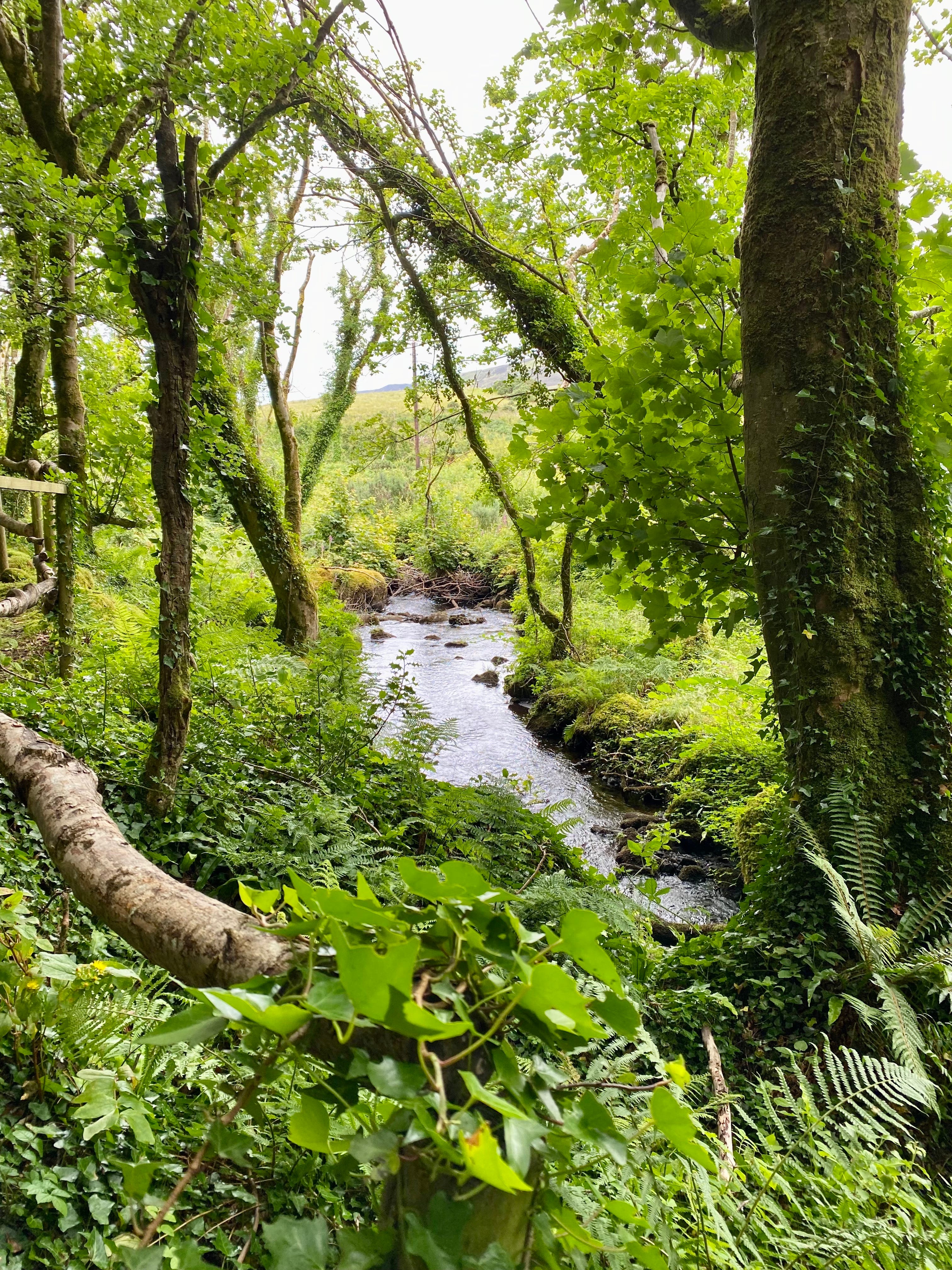
Last Saturday, the Feast of Our Lady of Mount Carmel, I had the privilege of celebrating this feast day with the Carmelite Community of Apostolic Hermits at Holy Hill Hermitage in County Sligo, Ireland. It is a community of vowed men and women, who describe themselves as “Roman Catholic in practice and ecumenical in outreach, with roots in the Carmelite contemplative tradition,” and who “aspire to create an environment characterized by solitude, simplicity and beauty, where community thrives, love is nurtured, prayer flourishes and the whole person can be transformed.”
“Apostolic Hermits” probably requires some explanation. As Discalced Carmelites, they are monastics in the tradition of the reform of the Carmelite Order instituted by St. Teresa of Avila in the 16th Century. As hermits, they live apart in separate hermitages (small cottages), coming together for morning and evening prayer services Wednesday through Saturday, and mass and a common meal on Sundays. Mondays and Tuesdays are spent in solitude.
As “apostolic” hermits, they provide a retreat ministry to encourage others to grow in the contemplative life. There are an additional ten hermitages for guests on retreat (I am staying in the St. John of the Cross Hermitage). Guests, as well as people from the local community, are welcome for the common worship services and Sunday meal.
It is a small community of three hermits, Sister Patricia of the Sacred Passion, Sister Cecilia of the Holy Spirit, and Brother Thomas of Christ. They are supported by a wider circle of “Friends of Carmel,” an ecumenical group of neighbors who support the mission of the Community and observe a rule of life adapted to the daily life of householders. In some ways, the Community is a revival of ancient Celtic Christianity, which was centered around monastic communities.
During the mass celebrating the Feast of Our Lady of Mount Carmel, Sr. Pat, Sr. Ceil, and Br. Thomas renewed their monastic vows, kneeling before the altar and reading vows of renewal that each had written. Each statement was a particular expression of thanksgiving and hope. It was a beautiful and inspirational witness to their vocation. It would be a good practice for the whole people of God to annually renew their baptismal vows in this way – not simply reciting the vows again, but reflecting in writing on the shape of those vows in their lives today in very personal terms.
After the service, Sr. Ceil mentioned to me that their practice has been to preserve these annual renewal vows, as a record of their spiritual journey. This journey has been a profound process of transformation for the hermits, all of whom have been in consecrated life for at least 40 years (62 years for Sr. Pat!). The beauty of holiness saturates their lives and the place where they dwell.
By “holiness” I mean wholeness. Their lives individually and collectively are complete, integrated. Their contemplative practice has borne fruit in the form of a very natural expression of their unique personalities. They are fully themselves (rather than being full of themselves!), living from the center of their being. By nurturing remembrance of their souls and having the courage to explore the depths of their inner life, they manifest the fullness of Christ in diverse ways. The integrity between their inner life and their outer life is manifest as a blessed simplicity.
The interior peace they experience is not the result of disconnecting from the world, but from reconnecting with the Beloved who communicates with us within our souls. The hermits here are very much aware of the suffering of the world. As St. Teresa observed,
just because the soul sits in perpetual peace does not mean that the faculties of sense and reason do, or the passions. There are always wars going on in the other dwellings of the soul. There is no lack of trials and exhaustion. But these battles rarely have the power anymore to unseat the soul from her place of peace . . .
Even though in the other dwellings of the interior castle it is noisy and chaotic and poisonous creatures slither around, no one can enter this innermost chamber and force the soul out of it. The things the soul hears cause her some distress, but they do not compel her to leave. This kind of suffering is not able to disturb her equanimity.2
Within the innermost chamber of our soul there is an inviolable space where we commune with God. When our lives are centered there, we know that nothing can separate us from the love of God. This is the peace of Christ that surpasses understanding, the peace that the world cannot give.
St. Teresa of Avila describes this state of consciousness as the spiritual marriage between the soul and God. It results in a “forgetfulness of self” in which everything in the soul is dedicated to honoring God. Her only wish is that God’s will be done, and is able to commit herself to loving service to others without fear. Interior peace is not something to be protected; in fact, we are assured that nothing can touch it. Thus, we are free to engage the world as agents of God’s love regardless of the consequences.
I have witnessed something of this peace in the lives of the hermits of Holy Hill. I’m very grateful for their generosity, hospitality, and loving service. The gathered community they have created might well be a new/old model of the Church.
What would it look like for you to live from the center of your soul? What would the renewal of your vows look like as a baptized person, a married person, an ordained person, and/or a consecrated person living from the center?
St. Teresa of Avila, The Interior Castle, translation and introduction by Mirabai Starr (New York: Riverhead Books, 2003), p. 260.
Ibid, p. 274.
Thank you, again, John. Profound words of a deep spiritual experience. I'm grateful to you and grateful that you are having this moment in your life. Love, John