
Vulnerability is our Superpower
Henri Nouwen on Responding to Injustice

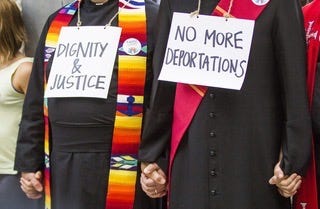
It is clear that we need to heal. It is clear we need to protest against violence and injustice. It is clear that we have to do anything possible to avoid oppression, exploitation, and war. But this ministry of healing has to be a ministry in the name of the One who healed through his wounds and who revealed his healing presence as the crucified one, who took the marks of his crucifixion into his new life with God.1
How do we respond to the reality of injustice in the world? This is a question that many of us struggle to answer. We want to be part of the solution. We want to be agents of healing, justice, and peace. Yet, when we acknowledge the scale of human and earth suffering, it is easy to become numb or exhausted. We tune-out or we burn-out. The key to sustained engagement with the ministry of healing is learning how to work with our vulnerability.
This is reflected beautifully in the life and teaching of Henri Nouwen. He recognized that vulnerability is our superpower. Accepting our confusion, fear, and weakness is the doorway to insight, compassion, and strength. Why is this so? Because we cannot heal what we do not love. And we cannot love what we do not know. We have to know and love our wounds to realize our gifts. Nouwen wrote, “I am deeply convinced that we can only work for the liberation of the people if we love them deeply. And we can only love them deeply if we recognize their gifts to us.”2
Vulnerability makes relationship possible: the recognition and sharing of suffering and gifts. The ministry of healing does not begin with what is wrong with the world, but with what is right with the world. People may be oppressed, but they are not powerless. Situations of injustice do not simply crush our spirits, they activate our imaginations. When we are open to sharing life with others, we begin to discover not only their pain, but their promise. Together, we become agents of our collective future, and not simply victims. To fail to see the giftedness in a situation of suffering is to compound its misery.
Nouwen learned this in his work alongside people with mental and physical disabilities at L’Arche Daybreak Community. In a letter to a colleague, he acknowledged that “they have a special gift to bring you closer to the heart of God. Their poverty reveals the heart. They teach me that human beings distinguish themselves from the rest of creation not so much by the mind as by the heart. The ability to give and receive love is what makes us human.”3 This from a man who wrote more than 40 books!
This mutuality in the sharing of gifts makes healing ministry sustainable. Over the course of his life, Henri Nouwen moved ever more close to people and situations of suffering, and in doing so experienced a profound sense of community, intimacy, and joy. He abandoned a distinguished academic career that took him through Notre Dame, Yale, and Harvard, to embrace pastoral ministry in the barrios of Lima and then at L’Arche. He chose to move closer to the pain of the world as an act of freedom, responsibility, and joy.
This is not easy. It wasn’t easy for Nouwen. We fear coming close to suffering, because we believe it is crushing. We feel helpless in the face of it, because we remain locked in our own ego rather than unlocking the power in relationship. But held in love by God and others, we can confront our fears and acknowledge our limits; this, too, is a gift. We discover that no person or situation is beyond the victory of love.
Nouwen’s life embodied the process of kenosis, of self-emptying, in which he became increasingly available to be a vessel of God’s love. As Nouwen embraced his vulnerability, he moved closer to others in their suffering and giftedness, realizing the intimacy and community that we all desire. This was very counter-cultural. We avoid pain and suffering. We scapegoat the victims of injustice. We persist in the delusion that our privilege can protect us; that success can substitute for belonging; that we can experience love without vulnerability.
Nouwen knew that the way of life is the way of the cross. Through his wounds he came in touch with others’ woundedness, and together they carried the marks of their crucifixion into their new life with God. Our vulnerability is our superpower because it makes space for the mercy of God to flow through us, and carry us into the joy of God’s promise to redeem all of life.
Working for social change, to me, means to make visible in time and place that which has already been accomplished in principle by God Himself. This makes it possible to struggle for a better world not out of frustration, resentment, anger or self-righteousness but out of care, love, forgiveness and gratitude.4
For Nouwen, moving closer to suffering and joy coincided with moving closer to God through Jesus Christ. His life alternated between engagement in the ministry of healing, and engagement in contemplative prayer. In fact, he understood this alternation to constitute one movement: “The contemplative life and the life with the poor seem very intimately connected.”5 Nouwen would frequently repair to the Abbey of the Genesee, a Cistercian monastery, for periods of solitude. There, he acknowledged his limits, and avoided burn-out by discerning what was his to do; and, what was not his to do.
If mutuality in the sharing of gifts makes healing ministry sustainable, it is an abiding sense of being held in God’s love that makes it possible. More than that: our being held in love transfigures our lives in such a way that they become more and more transparent to God’s love. It creates an energetic field that moves through us. We are not the source, we are simply the transmitter. In this sense, we do less and less, and God does more and more of the work.
It is so important for the people around you to see that peace of Christ reflected in your eyes, your hands and your words. There is more power in that than in all your teaching and organizing. That is the truth we need to keep telling each other.6
Healing ministry is as much about our “being” as it is our “doing.” It is a ministry of presence, human and divine. What do people see when they look at us? That is the most important question when it comes to responding to suffering and injustice.
Henri J. M. Nouwen, Love, Henri: Letters on the Spiritual Life (New York: Convergent Books, 2016), p. 276.
Nouwen, p. 63.
Nouwen, p. 110.
Nouwen, p. 64.
Nouwen, p. 86.
Nouwen, p. 88.