
Adding a Room or Burning Down the House
The continuing evolution of human consciousness


During the past two weeks I have been exploring Istanbul and Athens, two ancient cities rich in history and culture. Walking up to the Acropolis of Athens was a journey through time. It was also a journey through the structures of human consciousness. This rocky citadel has been inhabited for some 6,000 years, with evidence of a Mycenaean-age palace. As early as the 6th century BCE, it was the site of the cult of Athena, the titular deity of the city. Temples were built in her honor, the most famous being the Parthenon (pictured above) built in the 5th Century as part of the restoration of the Acropolis after it was sacked by the Persians.
By the 6th century CE, the Parthenon was a church dedicated to the Virgin Mary and served as the see of the diocese of Athens. The Temple of Athena Parthenos became the Church of the Parthenos Maria. After the Ottoman Empire conquered Greece in the 15th century CE, it became a mosque and was severely damaged during the Venetian siege in 1687. A smaller mosque remained amidst the rubble until the Greek’s regained control of the Acropolis in 1832 during their War for Independence. Since then, it has been an historical site now visited by millions of people each year.
The power of the old gods and goddesses is still palpable on the Acropolis, continuing to attract pilgrims to this thin space. They were not so much conquered as sublimated, submerged within the collective unconscious of humanity. If not properly integrated, they can irrupt with violent force. The Enlightenment “age of reason” did not destroy them any more than did the Christian or the Muslim eras that overlay them. They continue, mythologically, to express vital energies that must be integrated as human consciousness evolves.
At their best, this is what living religious traditions do. They dynamically integrate rather than repress the cosmic powers that constitute evolving structures of consciousness. Christianity began as synthesis of Jewish religion, Hellenistic mystery cults, Neoplatonic metaphysics, and Stoic ethics. St. Paul was clearly influenced by Cynic and Stoic philosophical ideas. The Gospel of John borrowed Stoic and Neoplatonic language in conversation with Jewish speculative philosophy. St. Gregory of Nazianzus and St. Basil the Great studied at the philosophical schools in Athens. Later, Islamic scholars were in conversation with all of these traditions.
Such syntheses are not evidence of contamination of an original, pure revelation, but rather evidence of the capacity to think; to imagine new ways of interpreting reality that foster cultural creativity. Human consciousness evolves by transcending and integrating previous interpretive structures, rebuilding on older foundations.

This layering of structures of human consciousness - archaic, magical, mythical, mental, and integrative in the typology of Jean Gebser1 - is visible in the physical structure and function of the Grand Mosque of Hagia Sophia. In this photo, two white curtains overlay a fresco of the Virgin Mary and Child painted on the ceiling above the apse. Hagia Sophia - the Great Church of Holy Wisdom - was built on the site of an ancient pagan temple in 360, and remained the see of the Ecumenical Patriarch of Constantinople until 1453, when it became a mosque during Ottoman rule. After a brief period as a museum of the Republic of Turkey from 1935-2020, it was again designated as a mosque.
The curtains do not quite conceal the Divine Mother. The mythic cannot conceal the archaic; she keeps peeking through the curtain. Reason cannot displace the mythical, and so the mosque-becomes-a-museum-becomes-a-mosque. These structures of consciousness are, as Cynthia Bourgeault notes, like rooms in a museum.2 You move among them, finding meaning in each room; making connections, seeing development and continuity, rather than simply tearing down one room and replacing it with another. Each must be honored and incorporated. We build out another room to accommodate new insights. When we refuse to do so, we end up burning down the house. That is the lesson of history.
We are living through a period in which the mythological level of human consciousness is irrupting in an expression of brutal nativism, misogyny and irrationality. This is, in part, because we have not honored the dynamic tensions within the polarities of being that the mythic expresses so well: body and mind, male and female, individual and communal, polis and cosmos. When only one end of the polarity is valued, the return of the repressed is inevitable and often disruptive until a new equilibrium is obtained.
Such irruptions often correspond with civilizational transitions. The decline of a particular constellation of social order and meaning is often marked by dramatic disequilibrium between these polarities, cultural exhaustion, political corruption and moral decadence. The irruption of the mythical today is occurring simultaneously with an evolution from the dominant, but incomplete, mental structure of consciousness, to the emerging integrative structure. The decline of the Pax Americana may be the birth pangs of this evolutionary development - the emergence of a new structure of human consciousness and not simply a destructive disequilibrium.
My recent journey through history was also a journey through the structures of consciousness etched in stone. It reminded me that the past cannot be erased, nor should it be. Civilizations and cultures rise and fall. Ways of perceiving and understanding reality emerge and merge and are synthesized into new constellations of meaning. My own religious tradition, Christianity, has been adaptive in its capacity to embrace new structures of consciousness, without denying the enduring validity of earlier structures. It is being challenged to do so again.
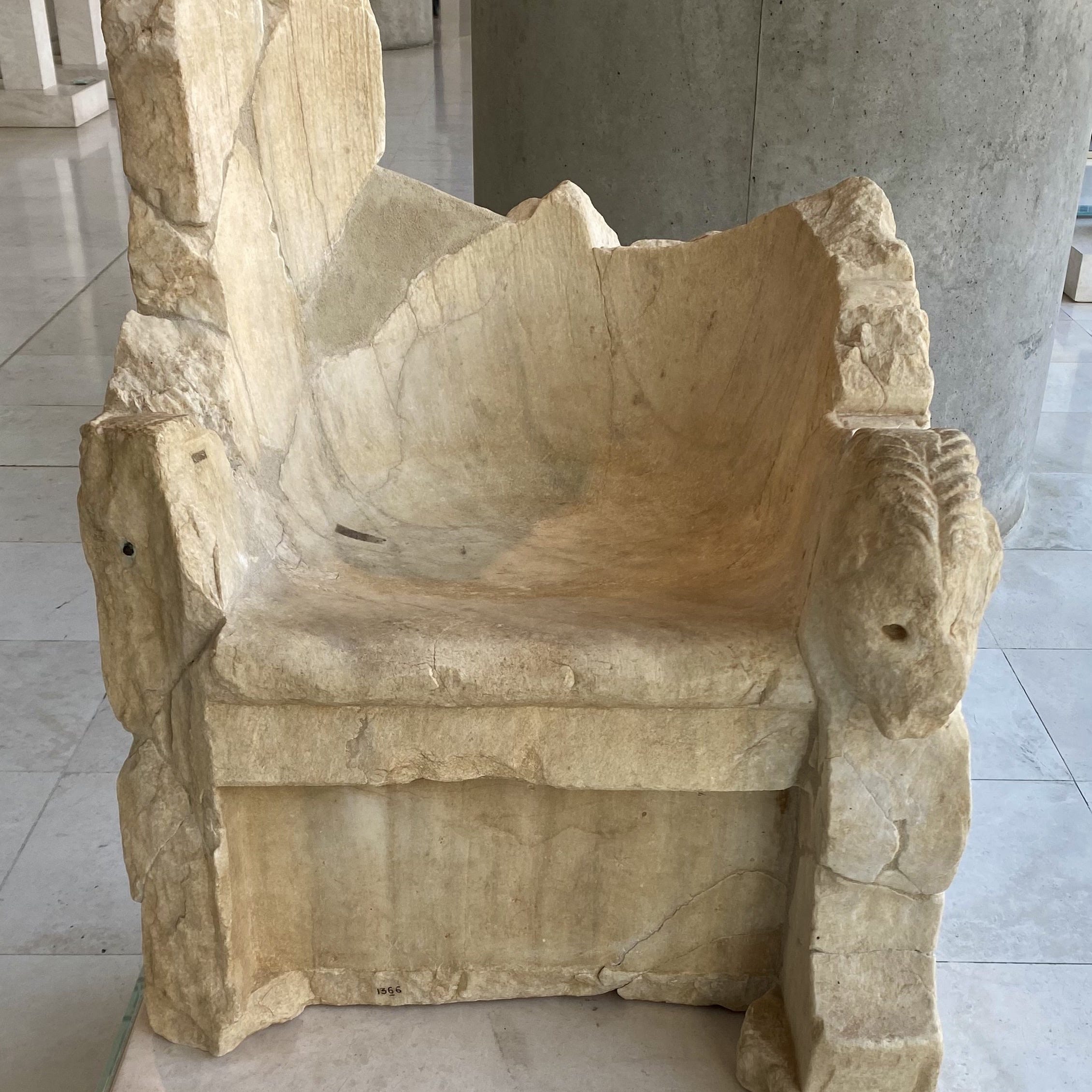
Wandering through the Acropolis museum, I was moved to photograph the remains of this 6th. century cathedra or bishop’s chair from the Parthenon. In Greek, “bishop” literally means “overseer”: one who sees “over” or comprehends the big picture. The cathedra symbolizes the perspective from which a unifying vision can be articulated. The occupant of the chair changes, but the role of seeing a unifying vision that gives meaning and purpose remains. This requires a new synthesis for our age, a continuing evolution in human consciousness emerging from the encounter between the great religious traditions, the new science, and the promise of multicultural democracy in a global civilization.
Will we add another room or burn down the house? What will the new synthesis look like?
Jean Gebser, The Ever-Present Origin (Athens: Ohio University Press, 1986).
See her discussion of Gebser at https://www.cynthiabourgeault.org/blog/2020/11/12/stages-versus-structures.
Another wonderful informative essay! I especially loved it because I am planning to visit Greece in April and will be there for Greek Easter. I will remember you words as I view all the layers of various civilizations as I travel around Greece. All the best to you and Andrew! Rose